

Moving to a new home means handling dozens of tasks at once. Getting your utilities connected properly should be at the top of your list, since electricity, water, and internet are non-negotiable on day one.
At LifeEventGuide, we’ve created this utility setup checklist for moving to help you stay organized and avoid costly delays. Follow our timeline and you’ll have everything running smoothly before you even unpack a box.
Which Utilities Need Your Immediate Attention
Electricity and gas rank as your first priority because without them, your home won’t function on day one. Contact your local electricity provider at least two weeks before moving to schedule activation. Most providers require your new address, move-in date, and a valid ID to open an account. If you’re moving within the same service area, ask whether you can transfer your existing account instead of creating a new one-this often speeds up the process and avoids duplicate deposits.
Electricity and Gas Setup
Gas setup follows the same timeline as electricity, though some areas use natural gas while others rely on propane tanks. Take meter readings on your move-in day and photograph them to prevent billing disputes. The average household spends around $138 monthly on electricity and $85 on gas, so accurate initial readings protect your budget from the start. Set up automatic payments with your provider to avoid late fees and missed deadlines.
Water and Sewer Connections
Water service requires contact with your city or water district, not a private company like electricity. Call at least two weeks ahead to arrange new service or a transfer. Ask about any deposits or connection fees upfront-some municipalities charge 50 to 200 dollars for new accounts. Schedule a final meter reading at your old home and a baseline reading at your new address on move-in day. This protects you from paying for water used by previous tenants and establishes your usage baseline for future bills.
Test all faucets and toilets on arrival to confirm water pressure and drainage work properly. Sewer service is often bundled with water, but verify this with your provider since some areas bill them separately. Locate your main water shut-off valve immediately upon arrival so you can respond quickly to emergencies.
Internet and Phone Service
Internet installation should be scheduled four to six weeks before moving if possible, especially in areas with limited provider options or high demand during peak moving season. Installation typically requires a technician visit lasting one to three hours, and availability windows can be tight. Confirm your new address’s internet availability before signing a contract-some rural areas have limited options.
Ask about fixed versus variable rates and contract terms, as early termination penalties can reach 150 to 300 dollars. Try to schedule installation for your move-in day or the day after so you’re not without connectivity while unpacking. Phone service through a mobile carrier requires no special setup, but if you’re transferring a landline, contact your provider two weeks ahead. With these essential utilities activated, you’re ready to tackle the next critical step in your moving timeline.
When to Contact Each Utility Provider
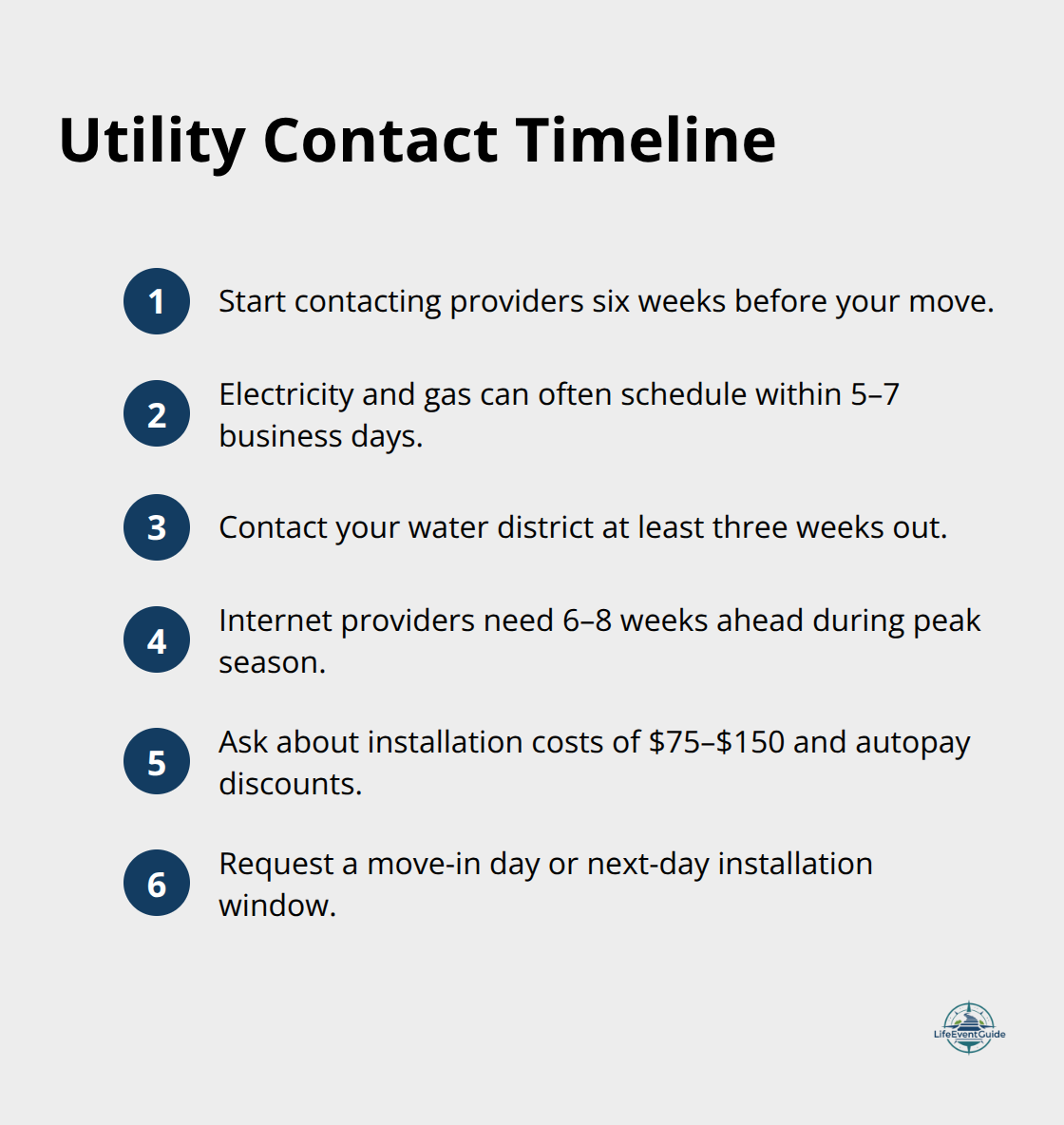
Start contacting utility providers six weeks before your move, not two weeks. Most people wait too long and miss installation windows, especially for internet, which has the longest lead times. Call your electricity and gas providers first since they activate remotely most easily. Most can schedule service within five to seven business days once you provide your new address and move-in date. Water and sewer services require more time because they’re municipal and often involve account setup at city offices. Contact your water district at least three weeks out to avoid the common mistake of arriving on move-in day without service activated. Internet providers need contact six to eight weeks ahead during peak moving season from May through September. Availability windows fill up fast, and some technicians book solid two months in advance. When you call, ask about installation costs, which typically range from 75 to 150 dollars, and whether they offer discounts for autopay setup. Request a move-in day or next-day installation window so you’re not waiting weeks for connectivity while unpacking.
Verify Your Appointments Two Weeks Before Moving
Two weeks before moving, you should have already scheduled electricity, gas, water, and internet. Now verify each appointment by calling providers back to confirm technician arrival times and any access requirements they need. Ask whether you need to be home during installation or if they can access the meter alone. For water service, confirm whether you need to attend a meter inspection or if the city handles it remotely. Request written confirmation of all scheduled dates and times so you have documentation if something goes wrong. Start gathering required documents now: government ID, Social Security number, proof of residency for your new address, and your lease or closing papers if applicable. Some providers conduct credit checks that take three to five business days, so don’t delay this step.
Schedule Disconnections at Your Old Home
Contact your old utility providers and request disconnection dates for one to two days after your move-out date, not on your move-out day itself. This overlap prevents gaps and gives you time to pack without rushing. Set up autopay with at least one utility now to establish the system before bills arrive. Most providers offer 5 to 10 dollar monthly discounts for autopay enrollment, which adds up to 60 to 120 dollars annually.
Test Everything on Move-In Day
On move-in day, your first task after arriving is testing utilities, not unpacking boxes. Turn on faucets in the kitchen, bathroom, and laundry area to confirm water pressure and check for leaks around pipes. Flush every toilet to verify drainage works and watch the tank refill without running continuously. Flip light switches throughout the home and plug in a lamp to confirm electricity is working. If lights flicker or outlets feel warm to the touch, contact your electricity provider immediately as this indicates a wiring problem. Smell your gas appliances and around the meter for any rotten-egg odor, which signals a potential gas leak. If you detect gas smell, leave the home immediately and call your gas company from outside. Test your internet connection by connecting a device to the router and loading a website to confirm the technician completed installation correctly.
Monitor Your First Bills Carefully
During your first week, take meter readings for electricity, gas, and water on day one and photograph them. Send these readings to your providers within 24 hours to establish your baseline and prevent billing disputes. Check your first bills carefully when they arrive, comparing the meter readings you photographed against what the provider billed. Utility billing errors happen in roughly 5 to 10 percent of accounts, so verification protects your account from overcharges. Within the first 30 days, review your bills against your expected costs based on the provider’s estimates. If usage is significantly higher or lower, contact the provider to adjust your budget billing plan or investigate potential leaks or equipment problems. Once your utilities are running smoothly and your bills are verified, you can shift focus to the next major task: setting up your home’s safety systems and addressing any maintenance issues that need attention before you settle in completely.
Mistakes That Cost Time and Money During Utility Setup
Disconnecting Too Early or Too Late at Your Old Address
Utility setup mistakes compound quickly during a move. The most damaging error occurs when you disconnect service at your old address on the wrong date. Most people either disconnect too early, leaving themselves without utilities while still packing, or forget to disconnect entirely and end up paying for an empty home for weeks. Contact your previous utility providers at least three weeks before moving and explicitly request disconnection for two to three days after your move-out date, not on move-out day itself. This overlap prevents service gaps and gives you flexibility if packing runs late.
Write down confirmation numbers and scheduled disconnection dates in a single document you can reference on moving day. Many providers charge 25 to 50 dollars monthly for service you’re not using, so a two-week billing error costs 50 to 100 dollars in wasted money. Request written confirmation of disconnection dates via email so you have proof if a provider bills you incorrectly afterward.
Underestimating Internet Installation Lead Times
Internet installation represents the second critical mistake area, and it’s the most common reason people face connectivity delays after moving. Many households underestimate how far in advance internet providers book appointments, especially during peak season from May through September when technicians schedule solid two months out. Waiting until two weeks before moving almost guarantees you won’t have service on day one. Contact internet providers six to eight weeks before your move, not four weeks.
Ask specifically about appointment availability for your exact move-in date and try for the earliest possible window. Some providers offer next-day or same-day installation if you book early enough, while others have minimum wait times of three to four weeks. Installation costs typically range from 75 to 150 dollars, and some providers waive fees if you commit to autopay, saving you money immediately.
Overlooking Local Municipal Requirements and Permits
The third mistake involves overlooking local municipal requirements that vary dramatically by location. Some cities require permits before water service activation, while others impose impact fees or demand proof of residency before opening accounts. Call your city or county clerk’s office at least four weeks before moving to ask about any permits, fees, or documentation requirements specific to your new address.
Some municipalities require in-person visits to establish water or sewer accounts, which you can’t handle remotely. Failing to complete this step delays service by weeks and forces you to arrange temporary water access. A few areas charge connection fees of 200 to 400 dollars that you won’t discover until you call, so budget accordingly. Document every requirement the city mentions and check them off as you complete them, since missing even one document can restart the entire process.
Final Thoughts
Your utility setup checklist for moving works because it transforms a chaotic process into a series of concrete actions with clear deadlines. Start contacting providers six weeks before you move, verify all appointments two weeks out, and test every utility on arrival. This timeline prevents the three mistakes that derail most moves: disconnecting service too early at your old home, underestimating internet installation lead times, and overlooking local municipal requirements that vary by location.
On move-in day, test water pressure, electrical outlets, and gas appliances before you unpack anything. Take meter readings and photograph them immediately so you have proof of your baseline usage for billing disputes. Within 30 days, review your first utility bills against the provider’s estimates and set up autopay to avoid late fees while securing the 5 to 10 dollar monthly discounts most providers offer.
We at LifeEventGuide created event-specific checklists and timelines to help you organize major life transitions like moving with clear goals and budgets. Use this utility setup checklist as your foundation, and you’ll move into your new home with confidence and without the stress of scrambling for basic services.
Publisher’s Note: LifeEventGuide is an independent educational publisher. Some articles reference tools or services we recommend to help readers explore options related to major life transitions. Learn more about how we make recommendations here.