

Introduction
A new name marks a new chapter—but the paperwork can feel endless. This comprehensive guide gives you a clear, steady path through every step of the name change process. Whether you’re taking your spouse’s surname, hyphenating, or creating a new family name together, the administrative journey is similar. Follow the checklist, keep copies organized, and move at a calm, sustainable pace. You’ve got this.
According to recent data from the Pew Research Center, approximately 79% of women in heterosexual marriages still choose to take their spouse’s last name, while 14% hyphenate, and 5% keep their maiden name.[1] Regardless of your choice, updating your legal identity requires navigating multiple federal, state, and private institutions—each with their own requirements and timelines.
Before You Begin: Gather These Essentials
Critical Documents:
- Certified copies of your marriage certificate (order 3–5 copies)
- Request these from the county clerk where you were married
- Cost typically ranges from $10–$30 per copy
- Processing time: 2–4 weeks in most jurisdictions
- Your current government-issued ID (driver’s license, state ID, or passport)
- Social Security card (if in the U.S.)
- Proof of residence (utility bill, lease agreement, or bank statement dated within the last 60 days)
- A simple tracking sheet or folder for confirmations and dates
Optional but Helpful:
- Passport-style photos (2–4 copies for various applications)
- Digital copies of all documents stored securely in cloud storage
- A dedicated email folder for name change confirmations
- Notarized copies of your marriage certificate for international use
Understanding the Legal Framework
In the United States, name changes through marriage are governed by state law, but federal agencies like the Social Security Administration (SSA) and the Department of State set their own requirements for updating federal records.[2] Most states recognize a marriage certificate as sufficient legal documentation for a name change, eliminating the need for a court order—a significant simplification compared to name changes for other reasons.
Quick Note on Order and Timing
Critical Sequencing: In the U.S., update Social Security first, then your driver’s license/state ID, then your passport. This order matters because:
- Social Security Administration (SSA) is the master federal database
- DMV/State agencies verify your name against SSA records
- Passport services cross-reference both SSA and state ID
- Financial institutions validate against government IDs
Most other updates can follow in any order. Expect some agencies to require in-person appointments. Build a simple weekly plan so you’re not rushing—spreading updates over 4–8 weeks is perfectly normal and sustainable.
Processing Time Reference:
- Social Security: Instant update in database, new card arrives in 7–10 days
- Driver’s License: Same-day issuance in most states
- Passport: 8–11 weeks standard, 5–7 weeks expedited[3]
- Financial institutions: 1–2 weeks for new cards
- Insurance providers: 1–3 business days for policy updates
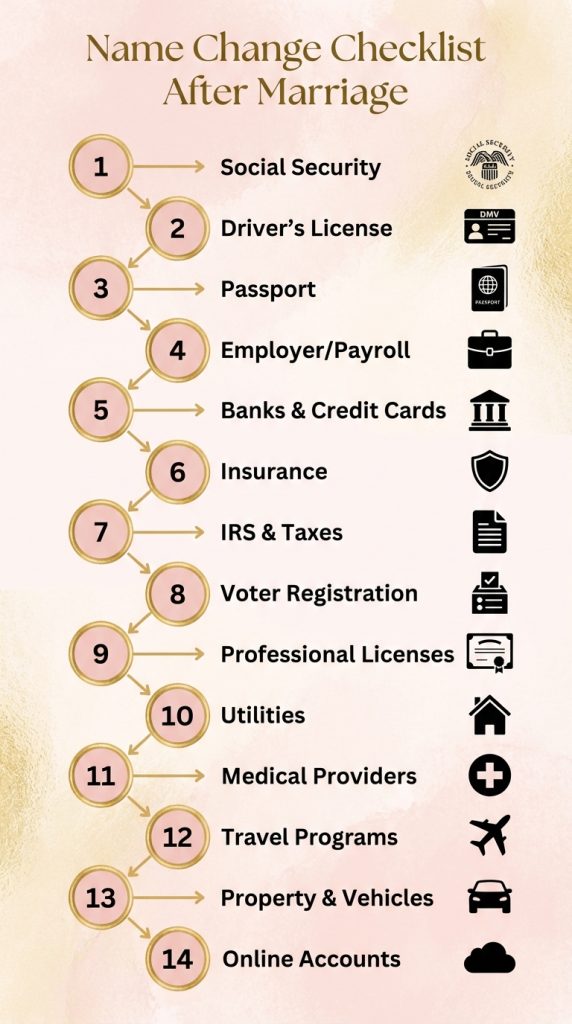
Step-by-Step Name Change Checklist (U.S.)
1. Social Security Administration
What to do: File a name change with the Social Security Administration.
Why first: The SSA database is the authoritative source for your legal name. Other federal agencies, employers, financial institutions, and credit bureaus validate identity against SSA records. Updating this first prevents delays and rejections downstream.[4]
What you’ll need:
- Form SS-5 (Application for a Social Security Card) – download from ssa.gov or pick up at any SSA office
- Original or certified copy of your marriage certificate
- Current government-issued photo ID (driver’s license, state ID, or U.S. passport)
How to complete:
- In person: Visit your local SSA office (no appointment needed, but expect wait times)
- By mail: Mail documents to your local office (only send certified copies, never originals except your current Social Security card)
Processing time: Your name is updated immediately in the system. Your new Social Security card arrives by mail in 7–10 business days.
Important tip: Request a printed receipt or confirmation with the date of your visit. Note this date in your tracking sheet—some DMVs ask when your SSA update was processed.
Special considerations:
- If you’re updating both your name and gender marker, you’ll need additional documentation
- Non-citizens may have additional requirements based on immigration status
- If you’ve lost your Social Security card, you can replace it during the same visit
2. Driver’s License or State ID
What to do: Update your name at the Department of Motor Vehicles (DMV) or equivalent state agency.
Timing: Wait 24–48 hours after your SSA visit to ensure the database sync is complete, though many people successfully update the same day.
What you’ll need:
- Updated Social Security confirmation (if available)
- Current driver’s license or state ID
- Certified marriage certificate
- Proof of address (utility bill, bank statement, or lease dated within 60–90 days)
State-specific variations:
- California: Requires proof of SSA update; allows same-visit voter registration update
- Texas: Accepts marriage certificate; new license issued immediately; $11 fee for duplicate license
- New York: Can update online within 30 days of address change; otherwise in-person required
- Florida: Requires in-person visit; no online option for name changes; first replacement free within 30 days of marriage[5]
Processing: Most states issue your new license immediately. Some provide a temporary paper license while your permanent card is mailed (7–14 days).
Helpful tip: Ask if you can update voter registration at the same visit—many states offer this convenience. Also inquire about organ donor registry updates if applicable.
3. U.S. Passport
What to do: Submit the appropriate passport application depending on when your current passport was issued.
Form selection:
- Form DS-5504 (free): If your current passport is less than one year old
- Form DS-82 ($130 fee): If your current passport is more than one year old but still valid
- Form DS-11 ($130 fee + execution fee): If your passport is expired
What you’ll need:
- Completed application form
- Your current passport (will be canceled and returned to you)
- Certified copy of your marriage certificate
- One new passport photo (2×2 inches, taken within the last 6 months)
- Payment for applicable fees
Submission methods:
- By mail: Send to the National Passport Processing Center (for DS-5504 and DS-82)
- In person: Required for DS-11 at a passport acceptance facility or agency
Processing times (as of 2026):[3]
- Routine service: 8–11 weeks
- Expedited service: 5–7 weeks (additional $60 fee)
- Agency appointment: 5 business days (for urgent travel; requires proof of travel within 14 days)
Travel planning tip: If you have international trips planned within 6 months, start your passport update early. Always ensure the name on your flight booking matches the name on the ID you’ll carry. Some travelers maintain their maiden name passport until expiration to avoid booking complications.
4. Employer, Payroll, and Benefits
What to update:
- HR/payroll system and employee records
- Direct deposit information (often requires re-verification)
- Health insurance enrollment
- Retirement accounts (401k, 403b, pension)
- Life insurance beneficiaries
- Flexible Spending Accounts (FSA) or Health Savings Accounts (HSA)
- Workplace email address and internal directory
- Employee ID badge and building access cards
- Professional email signature
Process: Contact your HR department as soon as your SSA update is complete. Most companies require:
- A copy of your marriage certificate
- Your new Social Security card (once received)
- Updated Form W-4 if changing withholding status
- Beneficiary designation forms if updating
Timeline: HR updates typically process within 1–2 pay periods. Verify your next paycheck stub shows your new legal name.
Important considerations:
- Update your name before open enrollment to avoid insurance coverage gaps
- Confirm your W-2 (issued in January) will reflect your legal name for tax filing
- If you have stock options or equity grants, verify these are updated to prevent future complications
- Request written confirmation from HR and save it to your documentation folder
5. Banks, Credit Cards, and Financial Institutions
What to update:
- Checking and savings accounts
- Credit cards (personal and business)
- Mortgage or home equity loans
- Auto loans and leases
- Student loans
- Personal loans
- Investment accounts (brokerage, IRA, Roth IRA)
- Cryptocurrency exchange accounts
- Payment apps (Venmo, PayPal, Cash App, Zelle)
What you’ll need:
- Valid government-issued ID with new name
- Certified copy of marriage certificate
- Account numbers for each institution
- Bank-specific forms (often available online or in-branch)
Process:
- In person: Visit your primary bank branch with documents; they can often update all accounts simultaneously
- By phone: Call customer service; may require mailing or uploading documents
- Online: Some institutions allow secure document upload through their portals
Timeline: Most banks process name changes within 3–5 business days. New debit/credit cards typically arrive within 7–10 days.
Critical follow-up steps:
- Order new checks with your new name
- Verify all automatic payments, direct deposits, and recurring transfers continue uninterrupted
- Update your name in mobile banking apps
- Confirm your credit report reflects the name change (more on this below)
Credit reporting agencies: Your creditors will report your name change to the three major credit bureaus (Equifax, Experian, TransUnion), but you can also notify them directly:
- The agencies will link your new and old names to your credit history
- Your credit score and history remain intact
- Request a free credit report 30 days after updates to verify accuracy[6]
6. Insurance Providers
Types of insurance to update:
- Health insurance (individual and employer-sponsored)
- Dental and vision insurance
- Auto insurance
- Homeowners or renters insurance
- Life insurance
- Disability insurance (short-term and long-term)
- Umbrella liability insurance
- Professional liability insurance (if applicable)
What you’ll need:
- Policy numbers
- Copy of marriage certificate
- New driver’s license (for auto insurance)
- Insurer-specific forms
Why it matters: An incorrect name on your insurance card can cause claims to be denied or delayed. Medical providers verify your identity against your insurance card, and any mismatch can create billing complications.[7]
Process:
- Contact each insurance provider’s customer service
- Many allow online updates through member portals
- Request updated insurance cards and policy documents
- Ask if the name change triggers any policy document reissuance
Timeline: Most insurance updates process within 1–3 business days. New insurance cards arrive within 7–10 days.
Important tip: Keep PDFs of all updated policy documents together in a dedicated digital folder. Update your insurance information in your phone’s emergency contact settings.
7. IRS and Tax Filing
What you need to know: The Internal Revenue Service (IRS) pulls your legal name from Social Security Administration records. Once your SSA name is updated, your tax filings should match automatically.[8]
Action items:
- Verify your W-2 reflects your new legal name before year-end
- If filing jointly, ensure both spouses’ names match SSA records
- Update your name with your tax preparer or tax software account
- If you file business taxes (1099, Schedule C), update your business entity records
Special consideration for newlyweds: If you married late in the tax year and haven’t completed your SSA name change before filing, you have two options:
- File under your maiden name (matching your SSA record at year-end)
- Complete your SSA update first, then file with your new name
Filing with a name that doesn’t match SSA records can delay refund processing by 6–8 weeks.
State taxes: Don’t forget to update your name with your state tax agency as well, especially if you file state returns separately.
8. Voter Registration
What to do: Update your voter registration to reflect your new legal name and current address.
Why it matters: Voter registration databases must match your current legal name and address for you to receive ballots and vote without complications.[9]
How to update:
- At the DMV: Many states allow simultaneous voter registration updates during your driver’s license visit
- Online: Most states offer online voter registration updates through their Secretary of State website
- By mail: Download and mail a voter registration form
- In person: Visit your county elections office
State-specific resources:
- National: vote.gov provides links to each state’s registration portal
- Deadlines: Check your state’s voter registration deadlines before elections
Timeline: Updates typically process within 2–4 weeks. You should receive a new voter registration card confirming your updated information.
9. Professional Licenses and Certifications
What might need updating:
- State professional licenses (medical, legal, nursing, teaching, real estate, cosmetology, etc.)
- Industry certifications (CPA, PE, PMP, etc.)
- Professional association memberships
- Bar association registration (for attorneys)
- Medical board registration (for physicians)
- Continuing Education (CE) transcripts and records
Process: Each licensing board has unique requirements. Most require:
- Official name change request form
- Copy of marriage certificate
- Current license number
- Reissuance fee (typically $20–$75)
Important considerations:
- Lead times: Some boards take 4–8 weeks to process name changes
- Certificate reissuance: Ask if a formal reissued certificate is required or if a database update suffices
- Wall certificates: Some professions require new wall certificates for display in offices
- CE credits: Verify your continuing education credits transfer to your new name without issue
Tip: Start professional license updates early in your name change process, as these often have the longest processing times.
10. Utilities and Household Accounts
What to update:
- Electric and gas utilities
- Water and sewer services
- Trash and recycling collection
- Internet service provider
- Cable or satellite TV
- Mobile phone account
- Landline (if applicable)
- Home security system
- Streaming services (Netflix, Hulu, Spotify, etc.)
- Smart home device accounts (Alexa, Google Home, Ring, Nest)
Process:
- Most utilities allow name changes via phone or online account portal
- Some may require a copy of your marriage certificate
- Joint accounts: Decide if you want individual or joint account holder status
Why it matters: Utility accounts in your legal name help establish proof of residence for other updates. They also ensure billing accuracy and credit reporting (if applicable).
Helpful tip: Take screenshots of your account settings before making changes. This allows you to verify all services, auto-payments, and account preferences transferred correctly.
11. Medical Providers, Schools, and Pharmacies
Healthcare providers to notify:
- Primary care physician
- Specialists (cardiologist, dermatologist, etc.)
- Dentist and orthodontist
- Eye doctor
- Mental health therapist or psychiatrist
- Physical therapist
- Chiropractor
- Patient portals (MyChart, FollowMyHealth, etc.)
Pharmacy updates:
- Retail pharmacy (CVS, Walgreens, etc.)
- Mail-order prescription services
- Pharmacy benefit manager (PBM)
What you’ll need:
- New government ID
- Updated insurance card
- Marriage certificate (some offices may request)
Process:
- Call each provider’s office to update records
- Bring your new ID and insurance card to your next appointment
- Update your name in patient portals yourself or request staff assistance
Why it matters: Accurate patient records prevent prescription errors, insurance claim denials, and medical record mix-ups. Your pharmacy profile must match your insurance exactly for coverage to process correctly.[10]
Educational institutions: If you’re currently enrolled in school or continuing education, update:
- Student records and ID
- Financial aid accounts (FAFSA)
- Student loan servicers
- University email and portal access
- Library card
- Alumni association records
12. Travel Programs and Loyalty Accounts
TSA PreCheck and Global Entry:
- TSA PreCheck: Update through the Universal Enrollment Services website or by visiting an enrollment center
- Global Entry, NEXUS, SENTRI: Update through your Trusted Traveler Programs (TTP) account
- No fee for name changes, but you must update before your next trip
- Failure to update can result in denial at security checkpoints
Airline loyalty programs:
- Frequent flyer accounts (American AAdvantage, Delta SkyMiles, United MileagePlus, etc.)
- Update through airline websites or customer service
- Critical: The name on your booking must match your ID exactly—even middle initials matter
Hotel and car rental programs:
- Hotel loyalty (Marriott Bonvoy, Hilton Honors, IHG Rewards, etc.)
- Car rental (Hertz Gold, Enterprise Plus, National Emerald Club, etc.)
- Vacation rental profiles (Airbnb, VRBO)
Other travel accounts:
- Travel credit cards (update through your card issuer)
- Travel booking platforms (Expedia, Kayak, Booking.com)
- Cruise line loyalty programs
- Passport services and expediting companies
Critical tip: Complete all travel program updates before booking new trips. Name mismatches can prevent boarding and are expensive to correct last-minute.
13. Vehicle Titles, Registration, and Property Deeds
Vehicle updates:
- Vehicle title: Update through your state DMV
- Vehicle registration: Often updated simultaneously with title
- Auto loan: Notify your lender (bank or credit union)
- Car insurance: (covered in Insurance section above)
Process varies by state:
- Some states require in-person visits
- Others allow mail-in forms
- Fees typically range from $15–$50
- May require current title, marriage certificate, and ID
Property and real estate:
- Home deed: Generally does not require updating immediately—your legal name is what matters, and a marriage certificate proves the connection
- Mortgage: Notify your mortgage servicer (especially for payment matching)
- Property tax records: Update with your county assessor
- Homeowners insurance: Update with your insurance provider
- HOA records: Notify your homeowners association
Trusts and estate planning documents: If you have:
- Living trusts
- Wills
- Power of attorney documents
- Healthcare directives
- Beneficiary designations
Consult with an estate planning attorney to determine if amendments or restatements are necessary. In most cases, a marriage certificate connects your previous and new identity, but complex trusts may require formal updates.
14. Digital Life and Online Accounts
Email accounts:
- Update display name in Gmail, Outlook, Yahoo, etc.
- Consider creating a new email with your married name
- Set up forwarding if transitioning email addresses
- Update email signatures
Social media profiles:
- Facebook, Instagram, Twitter/X, LinkedIn, TikTok
- Update profile names, usernames (if desired), and about sections
- Privacy consideration: You can keep your maiden name on social media if preferred
Cloud storage and productivity:
- Google Drive, iCloud, Dropbox, OneDrive
- Microsoft 365, Google Workspace accounts
- Password managers (LastPass, 1Password, Dashlane)
E-commerce and shopping:
- Amazon, eBay, Etsy
- Online grocery delivery (Instacart, Shipt)
- Retail accounts (Target, Walmart, etc.)
- Subscription boxes and auto-deliveries
E-signature and legal:
- DocuSign, HelloSign, Adobe Sign
- Online notary services
- Legal document platforms
Subscriptions and memberships:
- Streaming services (covered above)
- Gym and fitness memberships
- Professional networking sites
- Magazine and newspaper subscriptions
- Warehouse clubs (Costco, Sam’s Club)
Tip: Prioritize accounts where your legal name is required for payments or legal documents first, then update social and display names at your leisure.
Printable Mini-Checklist
Phase 1: Core Identity (Week 1-2)
- ☐ Social Security Administration
- ☐ Driver’s license/State ID
- ☐ Passport (if traveling internationally within 6 months)
- ☐ Voter registration
Phase 2: Work and Money (Week 2-3)
- ☐ Employer/payroll/benefits
- ☐ Banks and credit unions
- ☐ Credit cards
- ☐ Loans and mortgages
- ☐ Investment and retirement accounts
Phase 3: Insurance and Taxes (Week 3-4)
- ☐ Health insurance
- ☐ Dental and vision insurance
- ☐ Auto insurance
- ☐ Homeowners/renters insurance
- ☐ Life insurance
- ☐ Disability insurance
- ☐ IRS (via SSA automatic update)
Phase 4: Professional and Property (Week 4-6)
- ☐ Professional licenses
- ☐ Vehicle title and registration
- ☐ Property deeds (if needed)
- ☐ Trusts and estate documents
Phase 5: Daily Life (Week 5-8)
- ☐ Utilities (electric, gas, water)
- ☐ Phone and internet
- ☐ Streaming services
- ☐ Medical providers
- ☐ Dentist
- ☐ Pharmacy
- ☐ Veterinarian (for pet records)
Phase 6: Travel and Leisure (Week 6-8)
- ☐ TSA PreCheck/Global Entry
- ☐ Airline loyalty programs
- ☐ Hotel rewards programs
- ☐ Car rental memberships
Phase 7: Digital Life (Ongoing)
- ☐ Email display names
- ☐ Social media profiles
- ☐ Cloud storage accounts
- ☐ E-signature services
- ☐ E-commerce accounts
- ☐ Subscription services
How Long Will This Take?
Fast track: 2–3 weeks If you batch appointments, prep all documents in advance, and dedicate several full days to the process. This approach works well if you have time off after your wedding or honeymoon.
Standard pace: 4–8 weeks A steady, sustainable approach with minimal disruption to work and life. This is the recommended timeline for most people.
Extended timeline: 8–12 weeks If you’re traveling frequently, have complex professional licenses, or prefer spreading tasks across several months.
Time management tip: Schedule 90-minute focused blocks once or twice a week. Each block: one major agency visit or phone call + two quick online account updates. This rhythm prevents burnout and maintains progress.
Common Pitfalls (and How to Avoid Them)
1. Not ordering enough certified copies
The problem: Many agencies require original or certified copies of your marriage certificate. Ordering one or two copies forces you to wait for documents to return before proceeding to the next step.
The solution: Order 3–5 certified copies upfront. At $10–$30 per copy, this small investment saves weeks of waiting. Most counties allow online ordering through their vital records office.
2. Updating travel documents last-minute
The problem: Passport processing takes 8–11 weeks (5–7 weeks expedited). If you book international travel before updating your passport, you’ll face a name mismatch.
The solution: Align your ID updates with your travel calendar. If you have trips planned, either:
- Complete your passport update well in advance (3+ months before travel)
- Book travel under your maiden name until your new passport arrives
- Maintain consistency: name on ticket = name on traveling ID
3. Losing track of confirmations
The problem: When updating 20+ institutions, it’s easy to forget what’s done, what’s pending, and when you made each update. This causes duplicate efforts and missed updates.
The solution: Create a single tracking system (digital or physical):
- Spreadsheet with columns: Institution, Date Contacted, Confirmation Number, Date Completed, Notes
- Dedicated email folder for all confirmation emails
- File naming convention: “AgencyName_NameChange_YYYY-MM-DD.pdf”
- Cloud folder (Google Drive, Dropbox) for all documentation
4. Skipping professional licenses
The problem: Professional licensing boards often have 4–8 week processing times and specific requirements. Forgetting these can cause legal complications if you sign documents professionally.
The solution: Identify all licenses and certifications early. Start these updates in week 1 alongside Social Security. Create calendar reminders for any required continuing education or renewal dates.
5. Forgetting about automatic payments
The problem: When your bank issues a new credit or debit card with your new name, your old card number may be deactivated, breaking automatic payments.
The solution: Before requesting new cards, screenshot or document all automatic payments. After receiving new cards, systematically update each merchant. Check your bank statements for 2–3 months after to catch any failed payments.
6. Neglecting credit reports
The problem: Credit bureaus sometimes create separate profiles for different name variations, potentially fragmenting your credit history.
The solution: 30 days after completing bank and credit card updates, pull your free annual credit report from all three bureaus (annualcreditreport.com). Verify:
- Your new and old names are properly linked
- All accounts appear under your profile
- No errors or fraudulent accounts exist
7. Rushing the Social Security update
The problem: The SSA database is the foundation. Rushing to the DMV before the SSA update fully processes can cause rejections or delays.
The solution: Wait 24–48 hours after your SSA visit before attempting DMV updates. This gives the system time to synchronize. If visiting the DMV immediately, bring your SSA receipt as proof of update.
State-Specific Considerations
Name change requirements vary by state. Here are some notable differences:
Community Property States: In Arizona, California, Idaho, Louisiana, Nevada, New Mexico, Texas, Washington, and Wisconsin, special rules may apply to property ownership and name changes on deeds.[11]
States with Online DMV Name Changes: A growing number of states allow online driver’s license updates for name changes:
- Arizona (with requirements)
- Georgia (within 30 days of address change)
- Illinois (limited circumstances)
- Check your state DMV website for current options
States Requiring In-Person DMV Visits: Most states still require in-person visits for name changes:
- California, Texas, Florida, New York, Pennsylvania (among others)
- Bring all required documents to avoid multiple trips
Passport Agencies by Region: For urgent passport needs (travel within 14 days), you can visit a regional passport agency:
- Boston, Chicago, Detroit, Honolulu, Houston, Los Angeles, Miami, Minneapolis, New Orleans, New York City, Philadelphia, San Francisco, Seattle, Washington DC
- Appointment required; proof of urgent travel necessary[3]
International Considerations
If you’re a dual citizen:
- Update your name with both countries’ passport agencies
- Requirements and timelines vary significantly by country
- Some countries don’t recognize name changes after marriage
If you plan to travel internationally:
- Ensure your airline ticket name matches your passport exactly
- Some countries require a visa with your legal name
- Carry a certified copy of your marriage certificate when traveling during transition periods
If you’re married abroad:
- You may need to register your foreign marriage certificate with your home country
- Some states require an apostille (international certification) on foreign marriage certificates
- Contact your county clerk for specific requirements
Timeline for International Name Changes (Common Countries)
- United Kingdom: 2–3 weeks for passport update
- Canada: 20 business days for passport; varies by province for driver’s license
- Australia: 2–3 weeks for passport; varies by state for license
- European Union: Varies by country; typically 4–8 weeks
Special Situations
Hyphenating Your Last Name
If you’re hyphenating (e.g., Smith-Jones):
- Use the exact same hyphenation format everywhere
- Computer systems sometimes read hyphens differently
- Be consistent: Smith-Jones vs. Smith Jones vs. SmithJones
- Professional tip: Use the hyphenated form as your legal name, but you can use a shortened version professionally
Keeping Your Maiden Name Professionally
Many people maintain their maiden name for professional purposes:
- Use your legal name for: government IDs, taxes, insurance, financial accounts
- Use your professional name for: work email, publications, professional licenses, social media
- Disclose your legal name to HR and licensing boards
- This is completely legal and increasingly common
LGBTQ+ Couples and Name Changes
Same-sex couples have the same legal right to change names through marriage:
- The process is identical regardless of gender
- If both partners are changing names or creating a new combined surname, both will update through the same process
- Some couples choose to both take a hyphenated combination
Changing Your Child’s Last Name
If you have children from a previous relationship:
- Changing a child’s last name is a separate legal process
- Usually requires consent from both legal parents
- May require a court order
- Consult with a family law attorney for your specific situation
Financial and Legal Protections
Protecting Your Identity During Transition
During the name change process, you may have:
- Multiple valid IDs with different names
- Credit accounts under two names
- Professional records split across identities
To protect yourself:
- Keep certified copies of your marriage certificate readily accessible
- Maintain a file with old and new IDs during transition periods
- Monitor your credit reports for suspicious activity
- Use strong, unique passwords for all financial accounts
- Enable two-factor authentication wherever possible
- Consider a credit freeze during the transition if you’re concerned about identity theft
Tax Implications
Generally, there are no tax implications to changing your name, but keep these in mind:
- Your tax filing name must match SSA records
- If filing jointly, both spouses’ names must match SSA records
- Mismatches can delay refund processing
- Update your name before year-end to simplify tax season
Estate Planning Updates
Changing your name may require updates to:
- Will and living will
- Trusts (living trusts, irrevocable trusts)
- Power of attorney documents
- Healthcare directives and HIPAA authorizations
- Beneficiary designations (life insurance, retirement accounts, transfer-on-death accounts)
Recommendation: Schedule a consultation with your estate planning attorney within 6 months of your marriage to review all documents.
Frequently Asked Questions
Do I need to change my name everywhere?
No. You’re required to update your name where your legal identity, finances, or benefits depend on it (government IDs, banks, insurance, employment). Display names on social media and informal accounts can wait or remain unchanged if you prefer.
What if I’m hyphenating or keeping my maiden name professionally?
This is increasingly common. Use your legal name for government agencies, financial institutions, and anywhere legal identity verification occurs. Use your preferred professional name for work-related platforms, publications, and brand-facing contexts. Be transparent with HR and licensing boards about both names.
Do I need a lawyer?
Usually no. Marriage-based name changes are straightforward and don’t require legal assistance. However, consider consulting a professional for:
- Complex property ownership (multiple deeds, investment properties)
- Trust amendments or restatements
- Professional licensing in regulated fields (medical, legal)
- International name changes or dual citizenship issues
- Changing children’s names from previous relationships
Can I keep traveling during the process?
Yes—just ensure the name on your booking matches the ID you’ll carry for that trip. Options:
- Book under your maiden name and travel with your old ID (if still valid)
- Wait until you receive your new passport to book with your married name
- Carry your marriage certificate as proof of name change if using mixed documents (not guaranteed to work—airline discretion)
What if my Social Security update doesn’t show immediately at the DMV?
Wait 24–48 hours for database synchronization. If you’re at the DMV and facing issues, showing your SSA receipt sometimes allows processors to manually verify. If rejected, simply return in 1–2 days.
How do I change my name on my birth certificate?
You don’t. Birth certificates are historical documents and are never updated for name changes. Your marriage certificate serves as legal proof connecting your birth name to your married name.
What if I get divorced and want to reclaim my maiden name?
Your divorce decree typically includes provisions for name restoration. The process is similar to a marriage name change: update SSA first, then DMV, then cascade through other institutions. You’ll use your divorce decree as the legal documentation instead of a marriage certificate.
Can I change to a completely new name through marriage?
State laws vary. Most states allow you to take your spouse’s surname, hyphenate, or combine names. Creating an entirely new surname (not derived from either partner) may require a formal court-ordered name change in some jurisdictions. Check your state’s specific laws.
What happens to my professional publications under my maiden name?
They remain under your maiden name. Many professionals:
- Continue publishing under their maiden name
- Use both names with “née” (e.g., Dr. Jane Smith née Johnson)
- Include both names in author profiles
- Create a professional CV that bridges both identities
Will changing my name affect my credit score?
No. Your credit history is tied to your Social Security number, not your name. Credit bureaus will link both names to your single credit profile. Your score and history remain intact.[6]
How do I handle the transition period when I have IDs with different names?
Keep your marriage certificate accessible at all times. If questioned, it’s legal proof connecting both identities. During the 2–8 week transition, you may encounter:
- Insurance cards with your old name but prescriptions requiring new ID
- Bank cards with your old name but checks with your new name
- Mismatched IDs for travel
These are normal and expected. Most institutions understand and accommodate the transition period.
Resources and References
Official Government Resources
- Social Security Administration
- Name change information: https://www.ssa.gov/ssnumber/ss5doc.htm
- Find your local office: https://secure.ssa.gov/ICON/main.jsp
- Form SS-5: https://www.ssa.gov/forms/ss-5.pdf
- U.S. Department of State – Passport Services
- Name change on passport: https://travel.state.gov/content/travel/en/passports/need-passport/change-correct.html
- Form DS-5504: https://eforms.state.gov/Forms/ds5504.pdf
- Form DS-82: https://eforms.state.gov/Forms/ds82.pdf
- Processing times: https://travel.state.gov/content/travel/en/passports/how-apply/processing-times.html
- Internal Revenue Service (IRS)
- Name changes and tax filing: https://www.irs.gov/individuals/international-taxpayers/name-change
- Form W-4: https://www.irs.gov/pub/irs-pdf/fw4.pdf
- U.S. Election Assistance Commission
- Voter registration: https://www.eac.gov/voters/register-and-vote-in-your-state
- National Mail Voter Registration Form: https://www.eac.gov/sites/default/files/eac_assets/1/6/Federal_Voter_Registration_ENG.pdf
- USA.gov – Official Guide to Government Information
- Name changes: https://www.usa.gov/change-name
State DMV Resources
Each state has different requirements. Find your state DMV:
- DMV.org: https://www.dmv.org/ (unofficial but comprehensive)
- Official state DMV links: Search “[Your State] DMV name change”
Credit and Financial Resources
- Annual Credit Report
- Free annual credit reports: https://www.annualcreditreport.com
- Authorized by federal law; the only official site for free reports
- Consumer Financial Protection Bureau
- Name change and credit: https://www.consumerfinance.gov/
Professional and Academic Research
References Cited:
[1] Pew Research Center (2021). “The Enduring Grip of the Gender Pay Gap.” Pew Research Center Social & Demographic Trends. https://www.pewresearch.org/social-trends/
[2] Social Security Administration (2025). “Social Security Number and Card: How to Change Your Name.” https://www.ssa.gov/ssnumber/
[3] U.S. Department of State (2026). “Passport Processing Times and Name Changes.” Bureau of Consular Affairs. https://travel.state.gov/
[4] National Association of Social Security Claimants’ Representatives (2024). “Understanding Social Security Records and Identity Verification.” https://www.nosscr.org/
[5] American Association of Motor Vehicle Administrators (2025). “State Requirements for Driver License Name Changes.” https://www.aamva.org/
[6] Consumer Financial Protection Bureau (2024). “How Name Changes Affect Your Credit Report.” https://www.consumerfinance.gov/
[7] Centers for Medicare & Medicaid Services (2024). “Insurance Coverage and Identity Verification.” https://www.cms.gov/
[8] Internal Revenue Service (2026). “Taxpayer Identity and Name Matching Requirements.” IRS Publication 17. https://www.irs.gov/
[9] U.S. Election Assistance Commission (2024). “Maintaining Accurate Voter Registration Records.” https://www.eac.gov/
[10] American Medical Association (2024). “Patient Safety and Medical Record Accuracy.” JAMA Network. https://jamanetwork.com/
[11] National Conference of State Legislatures (2025). “State-by-State Marriage and Name Change Laws.” https://www.ncsl.org/
Additional Helpful Resources
Legal Information:
- Nolo – Free legal information on name changes: https://www.nolo.com/legal-encyclopedia/name-change
- FindLaw – State-specific name change laws: https://www.findlaw.com/
Wedding and Life Transition Resources:
- The Knot – Name change checklist: https://www.theknot.com/
- Brides – Wedding planning and name change guides: https://www.brides.com/
LGBTQ+ Specific Resources:
- National Center for Transgender Equality – ID documentation: https://transequality.org/documents
- Lambda Legal – Legal resources for LGBTQ+ couples: https://www.lambdalegal.org/
Downloadable Templates and Tools
To make your name change process even smoother, consider using these tools:
Tracking Spreadsheet Template: Create a spreadsheet with these columns:
- Institution/Agency Name
- Category (Government, Financial, Insurance, etc.)
- Priority (High, Medium, Low)
- Date Contacted
- Method (In-person, Phone, Online)
- Confirmation Number
- Date Completed
- Notes
- Follow-up Required (Yes/No)
Document Checklist:
- ☐ Marriage certificate ordered (quantity: ___)
- ☐ Marriage certificate received (date: ___)
- ☐ Current driver’s license (expires: ___)
- ☐ Current passport (expires: ___)
- ☐ Social Security card located
- ☐ Passport photos taken (date: ___)
- ☐ Proof of residence documents gathered
- ☐ Tracking folder created (digital/physical)
Closing: A Steady Finish
This isn’t a sprint—it’s a sequence. Your name change journey is personal, and there’s no single “right” timeline. Some people complete everything in two weeks; others spread it across three months. Both approaches are valid.
Remember:
- Move one step at a time
- Save every confirmation
- Celebrate progress as you go
- Ask for help when you need it (HR departments, DMV clerks, and customer service representatives handle name changes daily)
- Be patient with yourself during the transition
Your new name deserves a calm, confident arrival in every corner of your life. Marriage is a beautiful milestone, and while the paperwork feels administrative, it’s part of weaving your identities together legally, financially, and socially.
Final encouragement: Thousands of people navigate this process every day. Government agencies and private institutions have well-established procedures. You’re not alone, and you’re fully capable of completing this journey successfully.
Take a deep breath, pull out your tracking sheet, and tackle your first item. Before you know it, you’ll be signing documents with your new name like you’ve had it your whole life.
Congratulations on your marriage, and best wishes as you step into this new chapter—paperwork and all.
Publisher’s Note: LifeEventGuide is an independent educational publisher. Some articles reference tools or services we recommend to help readers explore options related to major life transitions. Learn more about how we make recommendations here.